

New Land Pattern Brown Bess Musket - Light Infantry Pattern 1812 - 1840
Peninsular War - War of 1812 - Waterloo - Colonial Wars - Mexican Army at the Alamo
by Gareth Newfield
After the signing of the Peace of Amiens between Great Britain and France in 1802, calls were made for the production of a more refined musket following the widespread adoption of the cheaper India Pattern during the French Revolution.
The resulting New Land Pattern was essentially a hybrid of features copied from the India Pattern and several experimental muskets produced during the 1790s. Heavily influenced by the earlier designs of the prominent London gun maker Henry Nock, the new musket bore several progressive features, including a streamlined stock and simplified brass furniture to ease manufacture. The flattened lock possessed a stronger, reinforced cock, and the internal springs were held in place by latches instead of screws. In common with many of Nock’s weapons, the ramrod incorporated a flared section below the button end to retain it in the ramrod channel and prevent loss. A further innovation was the retention of the 42 inch barrel by flat keys rather than wire pins, allowing the musket to be more easily disassembled.
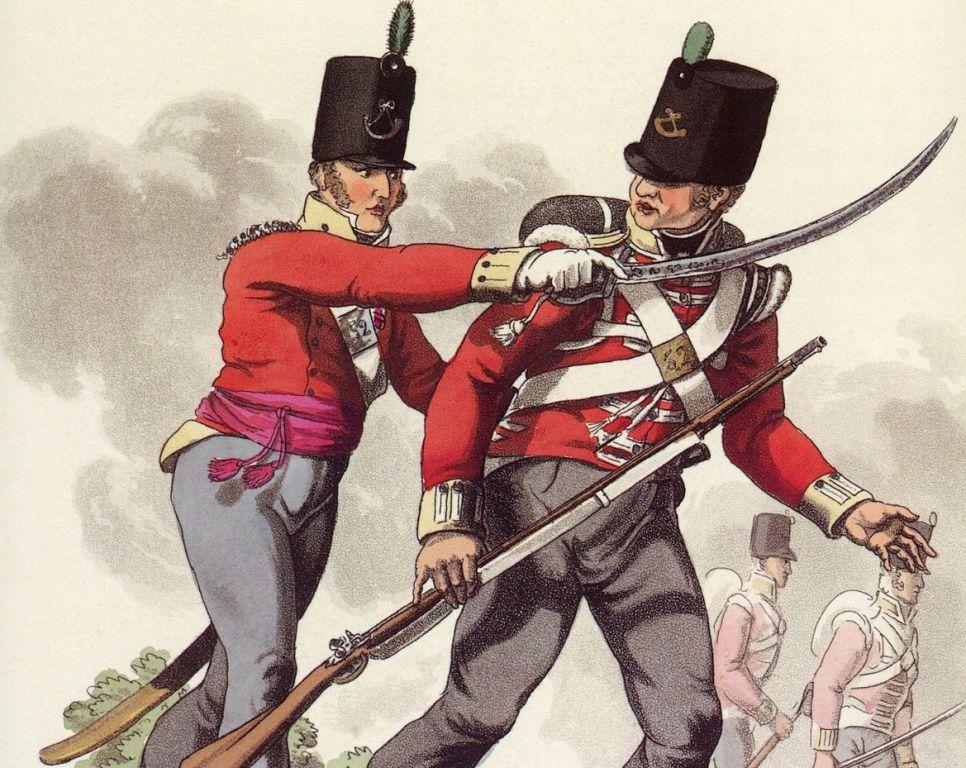
At the same time, the conversion of the 43rd and 52nd Regiments into light infantry in 1803 produced the demand for a weapon with which to arm these specialist troops. Accordingly, orders were issued for a modified version of the New Land Pattern, specifying “The barrel shall be browned, [and] a grooved sight shall be fixed at the Breech end ….” Although several hundred were delivered for trial, their quality was poor, and their use consequently limited. Moreover, the resumption of war with Napoleonic France that year curtailed the production of both variants of the New Land Pattern in favour of the cheaper and more readily available India Pattern.