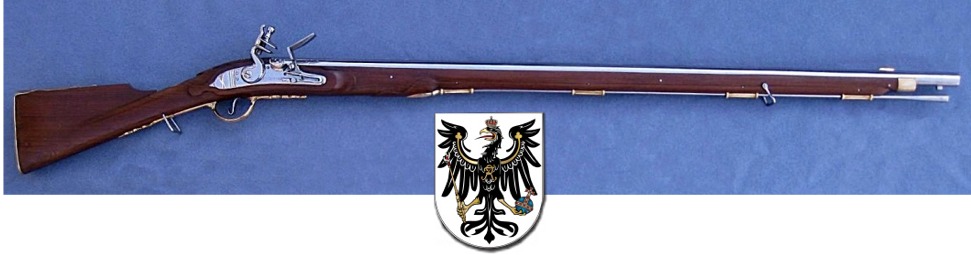
A reproduction of the 1740 Prussian pattern with Frederick the Great’s royal cypher and arsenal markings.
Supplied in a non-firing state.
Full view · 1 / 8Select a photograph to inspect
Technical details Specifications & construction
Barrel41 inches
Bore.75 calibre
he reproduction
offered here is a faithful copy of the original 1740 model complete with
Frederick the Great's royal cypher and "Potzdamn" insTpector and manufacturer
markings.
With a 41-inch long (.75 calibre) steel barrel, this musket
seems to have found the optimum point between ease of use and maximum
accuracy.
No wonder its use historically was so long.
The Prussians were famous for polishing their barrels
bright, so much so as to weaken their integrity.
Of course they did
not have the benefit of tempered seamless modern steel (type:BS970
no.080M40) like this reproduction is made from.
The breach is
of course tight.
The lock is made with strong durable springs and
has a case-hardened frizzen (hammer) that throws good sparks (our new process
of industrial hardening has made this even more durable).
We use an industrial case-hardening factory
process that makes sparking both more reliable and longer lasting.
Presently no other musket provider uses this technique.
As with all our
other flintlocks, the vent is not drilled (read details below) so we can ship easily to your door
throughout North America and to Europe.
Aside from that they
are exactly like
the originals.
A fine addition to any collection.
The story behind the pattern
History
Wars of the Austrian
Succession
-
Seven Years War
-
American Revolution
-
Napoleonic Wars
-
Waterloo
The year 1740
marked the crowning of a new king for Prussia: Frederick II.
Potzdam
had been Frederick's favourite place of residence and it is only fitting the
musket to be used by his army would be developed there
that same year.
Indeed "Potzdamn" had already made a name for itself
previous in 1723 for manufacturing the first standard German-made musket and
the 1740 model further solidified Potzdam as the key arsenal for the country.
Also in 1740 war had broken out when Frederick moved to take control of the
Austrian province of Sileria.
Arms had to be quickly manufactured and
rushed to his infantry regiments.
The following year, Sileria fell to Prussia
after the Battle of Mollwitz.
Unwilling to leave Sileria in Prussian
hands, Austria struck back in 1745.
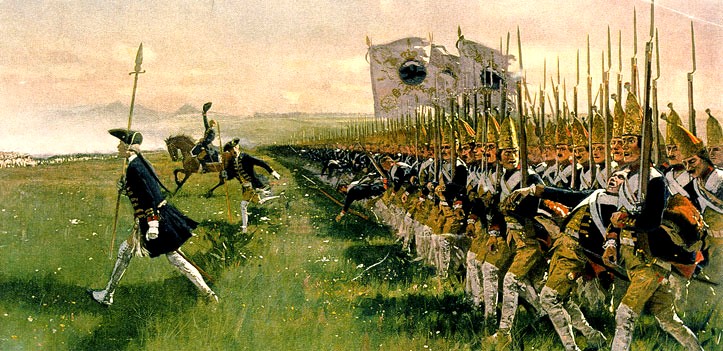
On June 4, the Battle of
Hohenfriedberg determined the fate of Sileria and it was there the 28-year old
Frederick was offered his moment to shine.
His brilliant defeat of the
Austro-Saxon Army at Hohenfriedberg left him with instant fame and he became
known as Frederick the Great.
Attack of the Prussian Infantry at the Battle of
Hohenfriedberg, 1745 (Carl Rochling)
Steeled by
an alliance with France and Russia, Austria was again challenging Frederick
the Great in the battlefield during the Seven Years War (1756-1763).
By
this point, the 1740 model muskets were in ready supply and Prussia turned to
supplying other allied German states.
Often outnumbered, the Prussian army fought
ferociously
throughout the war.
Even in Frederick's first defeat at Kolin in
1757, the Prussian Infantry showed great heroism.
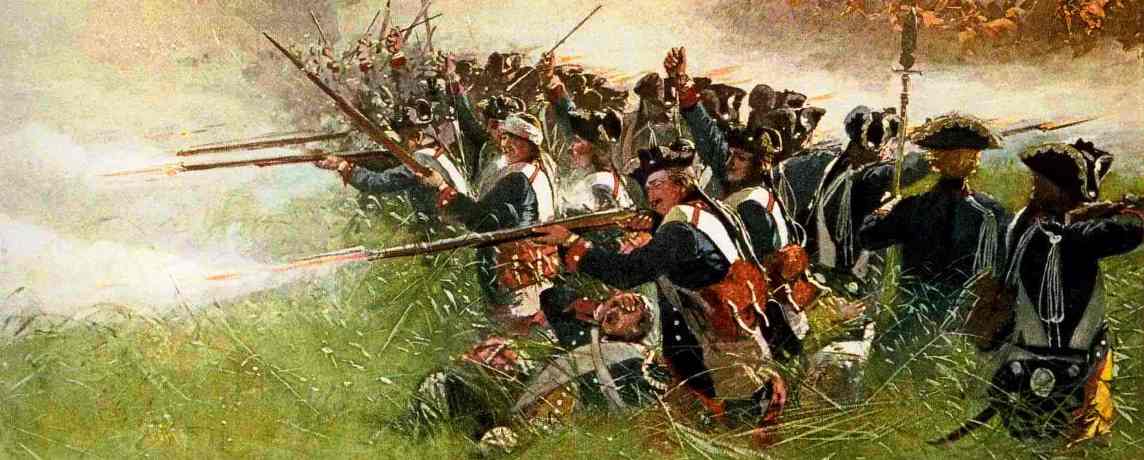
Protecting the
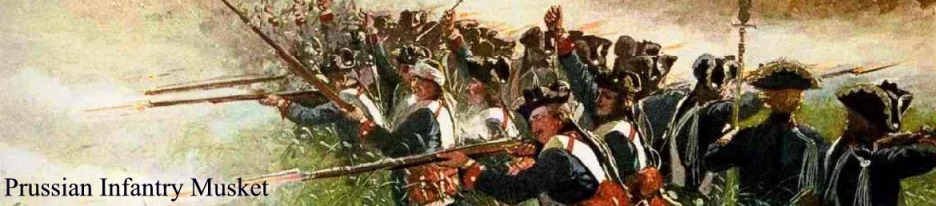
army's retreat, the Guards (Leibgarde) held the enemy cavalry at bay - at
one point firing volleys back-to-back (see image below).
Encouraging
his Guards, Frederick the Great commented: "Rascals, would you live
forever?"
Leibgarde Battalion covering the Prussian
retreat at the Battle of Kolin in 1757 (R. Knotel)
While Prussia
lost land in the war, the 1740 model became cemented as the weapon of choice
for the
country's infantry.
This would not change until 1809, making this
musket one of
the longest running national models of small arms in history.
It
is indeed Germany's most famous flintlock musket.
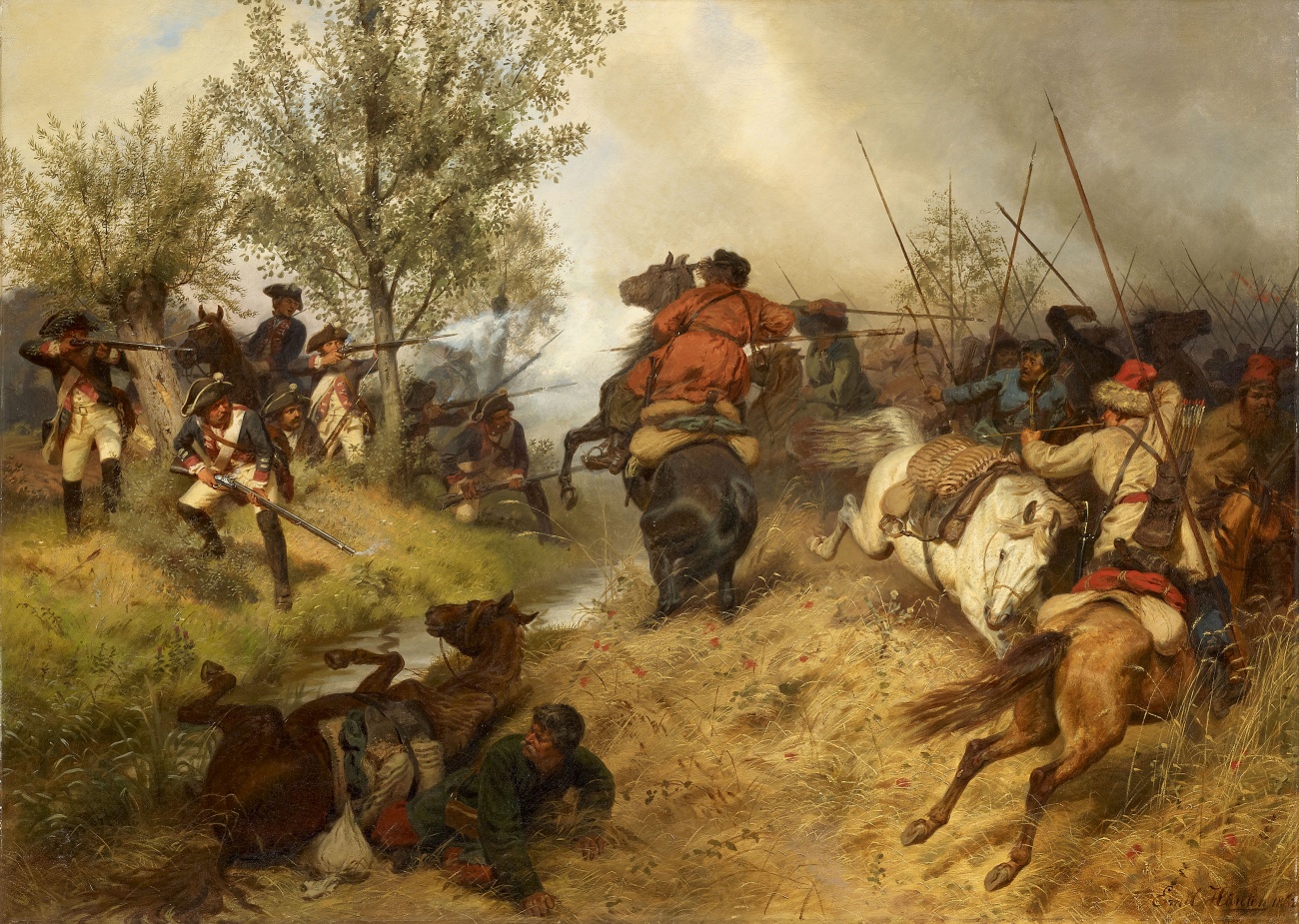
Prussian Infantry skirmishing with Russian
Cossacks in the battle of Zorndorf, 1758 (Emil Hunter)
North America
would also see this weapon in action.
To answer the rebellion in the
thirteen colonies, Great Britain deployed mercenary German regiments.
The surrender of a number of German units at the Battles of Trenton and
Saratoga, brought thousands of 1740 model Potzdam muskets into the hands of
American troops fighting for independence.
Back in Europe,
war again broke out in 1793 with the Flanders Campaign against
Revolutionary France.
Use of the 1740 model by Prussian infantry would
continue throughout the Napoleonic Wars.
After being
humiliated by Napoleon, a new model of Prussian Musket was finally authorized
in 1809(seen
here).
Still seven decades of manufacturing the 1740 model
made sure that it was still in use when the Prussian Army
arrived to save the day at the Battle of Waterloo,
resulting in the downfall of Napoleon.
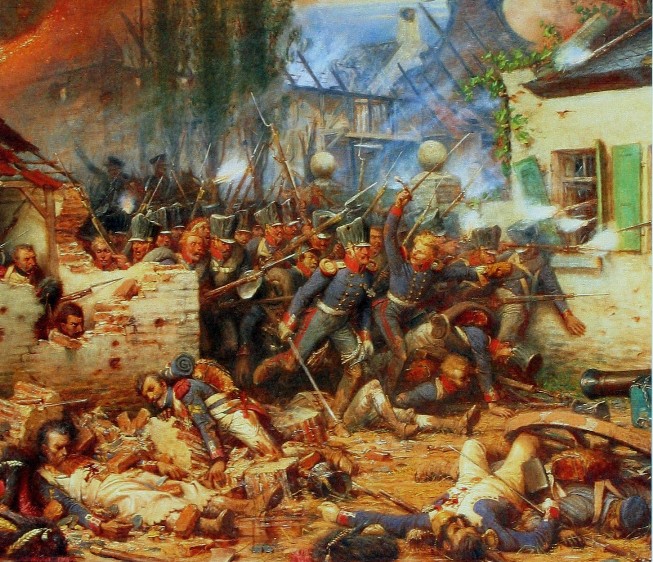
Prussian Infantry at the Village of Plancenoit
during the Battle of Waterloo, 1815
Our Guarantee
If upon receiving your musket you are not completely happy with
your purchase, you may return it for a refund. All we ask is you cover the
shipping costs. It has to be returned in two weeks of receipt and be in its
original state (unaltered and unmodified).
Non-Firing State
We sell historically accurate muskets and pistols in a non-firing state for demonstration purposes. This allows us to comply with various local, state, national and international firearms regulations, along with shipping company policy restrictions. This means the product comes right to your doorstep. A certified gunsmith may decide to alter a musket or pistol to a firing state by drilling the vent hole and test firing it. No need to remove the breech plug. We are not legally responsible for any changes from its present state. Please read our Conditions of Use and Legal Disclaimer. The customer is expected to be aware of the laws of their locality that govern products of this nature.