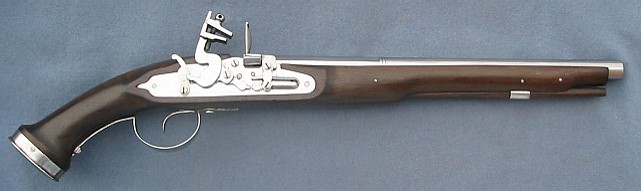
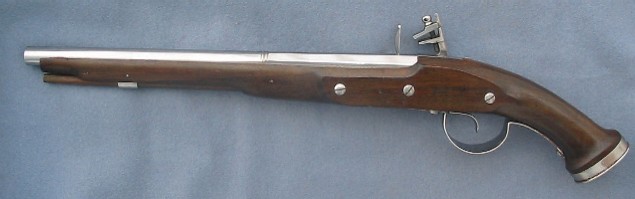
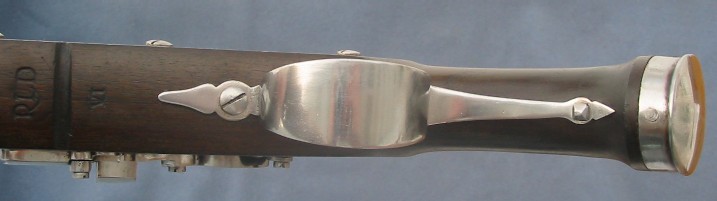
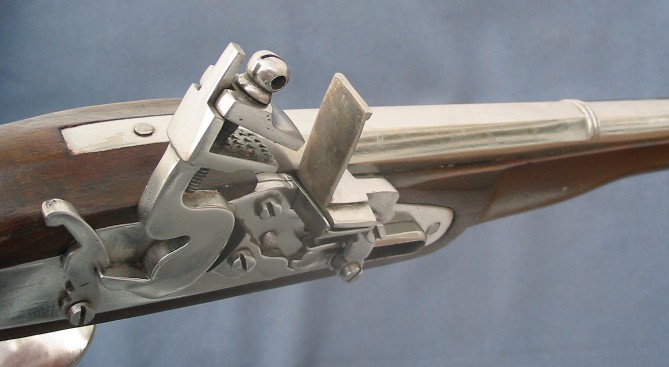
A long-barrelled doglock pistol reproduction recalling the English Civil War and the 17th century.
Supplied in a non-firing state.
Full view · 1 / 5Select a photograph to inspect
Technical details Specifications & construction
Barrel16 inches
Barrel profileOctagon to round
With it's 16-inch,
octagon-to-round barrel, this pistol must have been challenge to wield in the
melée of battle.
As with all of our flintlocks, this replica
is made faithful to those of the period with tempered seamless modern
steel (type:BS970 no.080M40)
with a tight
breech plug.
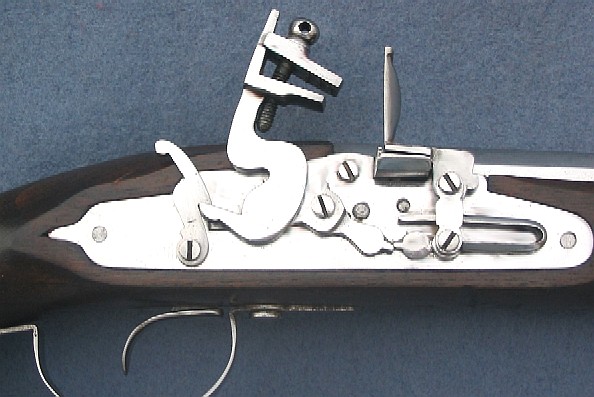
The lock is made with strong durable springs
and has a
case-hardened frizzen (hammer) that throws good sparks.
We use an industrial case-hardening factory process that makes sparking both more
reliable and longer lasting.
Presently no other musket provider uses
this technique.
As with all
our other flintlocks, the vent is not drilled (read details below) so we can ship easily to our
door throughout North America and to Europe and the UK.
Aside from that they
are exactly like
the originals.
A fine addition to any collection.
The story behind the pattern
History
This unique pistol
is an excellent representation of the evolution of flintlocks.
In the
collecting world this flintlock is called two names: (1) a simplified snaphaunce
or (2) an early dog lock.
Both descriptions are in fact correct.
To the learned collector, the elements of the snaphaunce are evident in the
sear lug protruding though the lockplate behind the cock, and the use of a
"buffer" to stop the descent of the cock when fired.
The
elements for the dog lock are obvious, namely the "dog" or lever
holding the cock at the half, and the introduction of a frizzen (replacing the
"battery" of the snaphaunce).
Therefore this is truly a transitional
piece in weapon's technology.
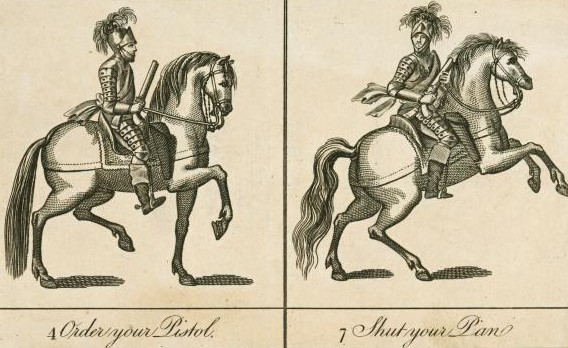
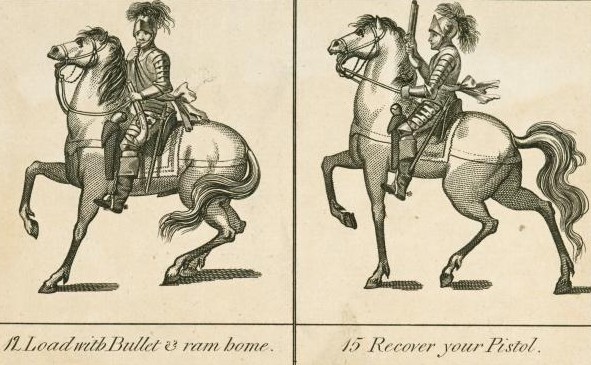
17th century English Cavalry
Pistol drill
This pistol saw
extensive use during the 17th Century.
It is most famous for its use by
the Royalist and Parliamentarian cavalry of the English Civil War.
Well
documented are the many engagements of the war where cavalry played a key role
in the fate of a battle.
Many of the cavalry "Roundheads"
sported a lobster style helmet and cuirass or chest plate, along with
"buff" coat made of buff leather from deer, and adorning
sashes.
However this pistol was not exclusive to the borders of
England.
In North America, locks of this configuration have been
found in 17th Century sites in North America.
They likely found a
place in the holsters of the cavalry of the colonies.
Cromwell's Ironsides charge Prince Rupert's
Horse, 1644 (Graham Turner - image is a link from external site)
Our Guarantee
If upon receiving
your musket you are not completely happy with your purchase, you may return it
for a refund.
All we ask is you cover the shipping costs. It has to be returned in two weeks of receipt and be in its original state (unaltered and unmodified).
Non-Firing State
We sell historically accurate muskets and pistols in a non-firing state for demonstration purposes. This allows us to comply with various local, state, national and international firearms regulations, along with shipping company policy restrictions. This means the product comes right to your doorstep. A certified gunsmith may decide to alter a musket or pistol to a firing state by drilling the vent hole and test firing it. No need to remove the breech plug. We are not legally responsible for any changes from its present state. Please read our Conditions of Use and Legal Disclaimer. The customer is expected to be aware of the laws of their locality that govern products of this nature.